Carnivorous plants do not eat humans or animals- just bugs! While some grow tall, like the 8-10 foot corpse flower ( Amorphophallus titanum” of Malaysia ), their traps and digestion suit tiny insects, not large producing meat.
While carnivorous plants supplement their nutrient intake by digesting prey, they also benefit surrounding ecosystems by regulating insect populations and providing specialized microhabitats.
What are Carnivorous Plants
Carnivorous plants are a unique group of plants that have evolved specialized leaves, traps, or digestive enzymes to attract, capture, and digest insects and other small prey to obtain additional nutrients, especially nitrogen, that are scarce in the nutrient-poor habitats where carnivorous plants are found.
These meat-eating plants are perennial in wetlands such as lakes, swamps, bogs, and marshes. Most of these plants are found in the southeast part of the country and stretch as far as California and Hawaii. Due to habitat loss, climate change, and other human-made factors, many of their species have gone extinct.
There are at least 583 species of carnivorous plants, and only a few of them are available to the public. ( We sure hope it stays that way, huh? ) Thanks to Darwin, the Father of modern botanical carnivore research, we can understand and admire what truly magnificent these carnivorous plants are and their ecology.
Carnivorous plants can trap, digest, and absorb nutrients from their prey using different techniques based on their species. They have been evolving independently throughout the decade, along with their environmental changes.
Due to their peculiarity, collecting them became an alarming phenomenon, leading to their extinction.

An example would be the famous Venus flytrap. According to The National Wildlife Federation, Venus flytraps are already listed as endangered species.
In North Carolina, the Venus flytrap is considered a “Species of Special Concern,” and poaching has been a felony since 2014.
Predatory Plants Dietary Preferences
Thriving in nutrient-deficient, marshy habitats, carnivorous plants employ a unique feeding strategy, extracting vital supplements from insects, arachnids, small amphibians, and other creatures. Contrary to popular belief, these predatory plants selectively choose their prey, as not all airborne insects become part of their menu.
In essence, carnivorous plants rely on insects for nitrogen fixation, a crucial element for distinguishing potential prey from pollinators. This nuanced approach to feeding ensures their survival.
The Smithsonian Institution has conducted a comprehensive assessment, shedding light on carnivorous plants’ intricate techniques for discerning and separating their intended targets from pollinators.
Carnivorous Plants Separation Technique
Ever wondered how carnivorous plants skillfully distinguish their prey from pollinators? These insect-eating wonders employ unique techniques, thoroughly assessed by the Smithsonian Institution.
Spatial separation
To optimize their predatory prowess, carnivorous plants strategically position their flowers above the ground, attracting flying pollinators. Simultaneously, their traps are strategically close to the ground, enticing crawling insects into their clutches.
Temporal separation
Executing a well-timed sequence, these plants first attract pollinators with their flowers before developing traps to secure their prey. The orchestrated dance of spatial and temporal separation showcases the sophisticated strategies these botanical predators employ for effective hunting.
Meat-Eating Plants Traps
Carnivorous plants have some crafty tricks up their leafy sleeves to lure and digest insect prey. They use sweet smells, bright colors, and movement that mimic food sources to attract bugs. When an unlucky insect is lured into a trap, the plant releases enzymes to break down its captive into nutrients.
Traps like sticky flypaper, snap jaws, and pitfalls allow carnivorous plants to feast on bugs to thrive where soil nutrients are scarce. These innovative survival strategies make carnivorous plants some of the most ingenious in the plant kingdom.
Except for the Nepenthes bicalcarata, which doesn’t have digestive enzymes for its trapping technique.
Snap trap

These plants automatically snap to catch prey when the hair is triggered or touched. An example would be the Venus flytrap; sensing its victim’s panic, it stimulates its trapping mechanism and digestive enzymes.
Lobster-pot trap

The lobster pot trap is a passive trapping mechanism that allows the insect to crawl deep into a trap, thinking there’s food or nectar inside. Insects are attracted to the pitcher by nectar and coloration but find it difficult to escape due to the inward-pointing hairs and slippery walls.
Bladder trap

These plants have small, bladder-like structures that are under negative pressure. When triggered, this carnivorous plant pulls prey like a vacuum once it triggers its miniature trap doors. Only bladderwort plants use this trapping technique for their aquatic and semi-aquatic prey.
Passive flypaper traps
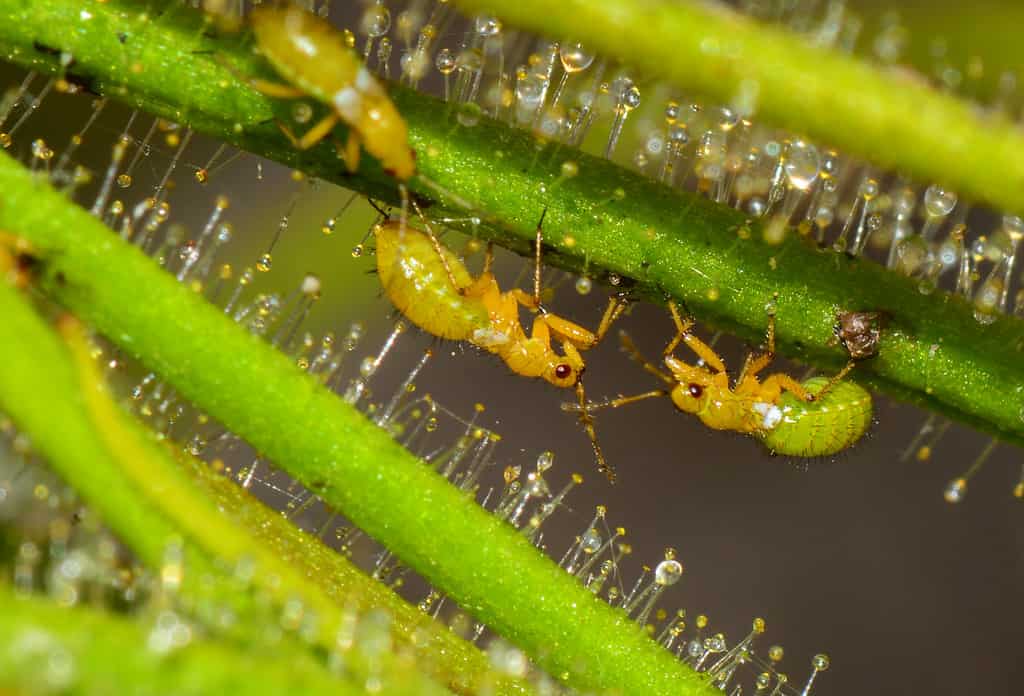
Rely on their sticky substance when the surface of their leaves or stems is triggered. They are immobilizing their prey without escaping. This is similar to the passive pitfall trap. Sundews and Butterworts both have this trapping mechanism.
Carnivorous Plants Care Guide
Light

Full sun to bright, indirect light. Remember, they need the sun’s energy for photosynthesis.
Water

Use pure water, such as rainwater or distilled water. If either of the two types is unavailable during the feed, you can use tap water, as long as it has been stilled for 24 hours, to remove significant contaminants such as arsenic, chlorine, and pesticides.
Distilled water would be necessary if you’re growing these meat-eating plants in hot or dry climate regions.
Potting Mix
Carnivorous plants thrive in nutrient-poor growing mediums that mimic their natural boggy habitats, so create a peat-free, ericaceous compost blend to provide the ideal carnivorous plant potting mix.
Fertilizer
Avoid using fertilizer on carnivorous plants since they obtain sufficient nutrients by trapping and digesting insect prey. Adding fertilizer can damage or kill carnivorous plants adapted to nutrient-poor conditions in their native habitats.
These unique plants get all the nitrogen, phosphorus, and other minerals they need from the bugs they catch in their specialized traps and digestive enzymes.
Pruning
As carnivorous plants go dormant in autumn and winter, it is important to prune away any dead flowers, turned-black traps, or damaged foliage. Carefully clipping off deceased plant tissues encourages future growth and allows the plant to conserve energy rather than waste resources on decaying material.
Regular pruning maintains an attractive appearance and healthy plant shape.
Temperature and Humidity
Fifty degrees Fahrenheit and above. Most carnivorous plants thrive in highly humid areas. Putting them in a terrarium would be great if you bring them indoors.

Although carnivorous plants thrive outdoors, we can grow them indoors. It may not be able to eliminate all the bugs and insects in your home, but it will control the situation.
5 Most Famous Insect-Eating Plants You Can Grow at Home
Venus flytraps ( Dionaea muscipula )

Venus flytraps are famous meat-eating plants that feed on insects and arachnids. They best thrive outdoors in full sun, sitting in clean water. It may take days for Venus flytraps to digest their food, and it will take months for their next meal.
Butterworts ( Pinguicula )

A succulent-looking carnivorous plant. Butterworts use their adhesive pads to trap small insects and have an attractive bloom to attract pollinators. Unlike the Venus fly trap, which thrives in full sun, butterworts appreciate bright, indirect light.
One famous butterwort species is the pink-flowering Pinguicula moranensis, which can best be placed in a terrarium or near a glass window.
Sundews

This carnivorous plant doesn’t go to dormancy compared to the butterworts. You can grow different types of sundew in one container with clean water and bright light. A sunny windowsill would be an ideal place in the house to put them.
These cute buggers feed on insects, tiny organisms, and mosquito larvae like many species feed on. Sundews possess tentacles with sticky droplets. Once insects are trapped, it produce enzymes to break them down, enabling the plant to absorb the nutrients it needs.
Check our Sundew Plant Care article for more care guide tips.
Pitcher Plants

The pitcher is another famous carnivorous plant with a slippery surface from which more enormous insects slide and get trapped. It produces slimy fluid to drown its prey, making it impossible to escape. This plant appreciates bright light to partial shade.
If your home has plenty of wasps, flies, and ants, pitcher plants will love it. Tropical pitcher plants ( Nepenthes) and American pitcher plants ( Sarracenia spp ) thrive best outdoors in direct sun among other carnivorous plants. Still, they can also be grown indoors near a sunny window with sheer curtains.
If your home doesn’t have natural light coming in, you can use fluorescent or other cool-temperature grow lights for support. All carnivorous plants love high humidity; pitcher plants are no different. An indoor terrarium or outdoor wet garden would be ideal for these beautiful creatures.
Bladderworts

Bladderwort carnivorous plant has multiple bladders to trap insects. When its hair is triggered, it traps the insects and closes its leaves like a vacuum. This plant is perfect for keeping the mosquitoes in your house at bay.
If you want to experience the natural wonders of the meat-eating plants, the United States Botanic Gardens (USBG) “Savage Garden” showcases how they interact, live, and trap insects via exhibits, sculptures, and hands-on activity. Within the USBG’s impressive collection, visitors can admire the unique adaptations and captivating beauty of these insect-eating wonders.
Whether you want to buy, sell or simply reach out to other plant enthusiasts, Plantly is the right place to be!