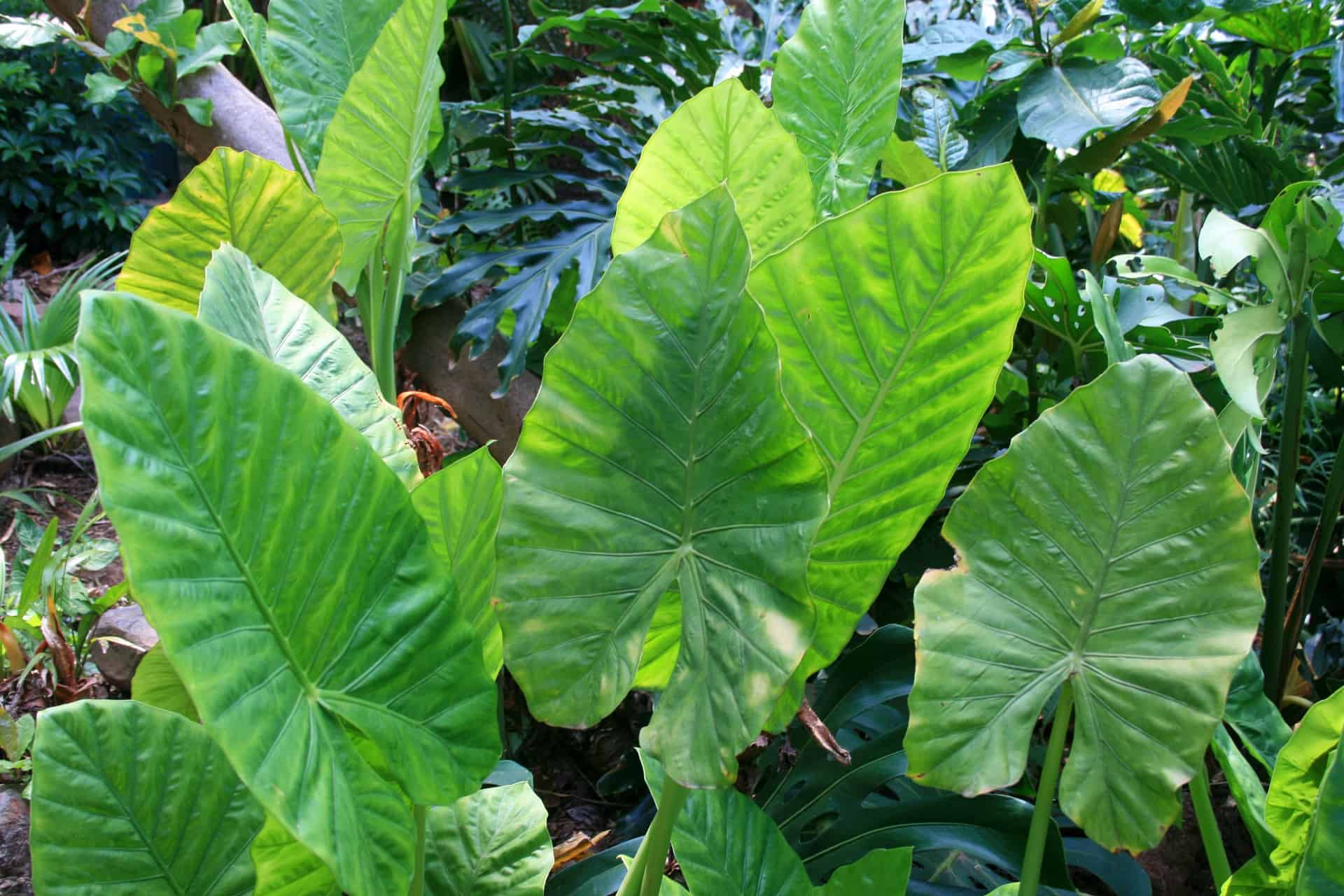
One of the biggest Alocasia calidora plants you can get is the elephant’s ear. But it is not only the huge leaves that are attractive. No, it is a low-maintenance plant and sure to be a treat for anyone’s eyes when passing by.
So, if you want to create a tropical nature indoors, this plant will help you achieve that.
More About Elephant Ear Plant
The Alocasia calidora plant is native to the subtropical and tropical parts of Asia and Eastern Australia. The elephant’s ear is grown indoors and outdoors depending on the USDA hardiness zones, making for an exceptional ornamental plant.
The calidora plant belongs to the Araceae family and can have different names, like elephant ears or taro. The plant can grow up to 13 feet tall, but as indoor plants, they reach heights of 9 feet tall to 3.5 feet wide.
Furthermore, you find variegated cultivars with leaves in the color green, purple, and white. The evergreen perennial has ribbed foliage like arrows with an upright growth on the petioles. When grown in direct sun, numerous clumps form at the base and top.
When grown inside, it seldom blooms and can expect moderate growth during spring and summer in the USDA zones 9-11. Still, for plant parents with children and pets, a note of warning is that all parts of the plant are toxic and contain oxalic acid causing skin irritation.
Yet, it does have some edible varieties in the genus available when cooked sufficiently, breaking down the toxic acid. The fact is that this plant you find widely cultivated in Borneo.

Caring For Alocasia Calidora Plant

Alocasia species is easy to grow and a hardy plant indoors. Still, your Alocasia plant has special soil, moisture, and light needs. So, please read about how to care for your elephant ear plant here with us.
Best Soil For Elephant’s Ear
For your plant to thrive, it helps to use suitable potting soil to allow it to grow at its full potential and be healthy. The Alocasia calidora prefers well-draining soil that is moist but not soggy.
We recommend using chunky, airy, porous, damp soil for new foliage growth to make your plant spread out its leaves. Such a potting mix will hold moisture but allow excess water to drain through the drainage holes at the bottom of the container.
For this reason, using equal mixes of organic, aroid, and a good fertilizer helps. In addition, you can add perlite, peat moss, or a compass to the soil. Finally, for too-weighty soil, amend it with some sand to provide the right soil texture your tropical species needs.
Keep the recommended pH level slightly acidic to neutral between 5.5 and 6.5. The acidity helps your Alocasia calidora plant absorb more nutrients as it has moderate watering needs.
Suitable Light For Calidora Plant

With the correct well-drained yet moist soil, your plant needs the right lighting conditions to ensure that jungle vibes. Here it is essential to prevent too much full sun or complete shade. Continuous exposure to direct sunlight results in leaf scorch, while too little sunlight limits growth in your new plant.
Planting your Alocasia calidora outdoors helps to keep it in bright indirect light during the intense hours of the day. Still, if your plant’s growth is too big to move the pot, we recommend using some shade cloth to protect it from direct light and provide some filtered light instead.
As indoor plants, the elephant ear will do well in a spot at the north or southwest-facing window to receive the right amount of light. Alternatively, you can grow it under artificial growing lights.
Watering Alocasia Calidora Plant

The beautiful elephant ears have the exact watering needs as most houseplants. Still, even with good drainage in the pot, it is best to avoid overwatering or provide inadequate watering with this plant resulting in wilting and yellow leaves.
We recommend allowing the soil to dry but not completely dry or too wet in between watering. The best is to use the old-fashioned method of sticking your finger into the soil. Gardening tools like a moisture meter measuring water content are also helpful.
Both under and overwatering have severe results for your plant. You may find that your plant will need more water during the growing seasons in spring and summer. While in winter, the watering will become less.
Another helpful care tip is to use chlorine-free water, and if you need to use tap water, we recommend leaving it to stand for 24 hours, allowing the chemicals to evaporate.
Fertilizing Alocasia Calidora
For plant root development, it helps to feed your Alocasia calidora a balanced fertilizer. You can find several fertilizer types available to make your plant thrive, like a slow-release fertilizer.
We recommend using one during the growing season and fall but not winter. Like a liquid fertilizer, a quick-release fertilizer helps you use it twice a week in the summer and spring. For slow-release feeds, twice a month will provide excellent results.
Still, choose one high in nitrogen, phosphate, and potassium.
Temperature and Humidity
While the plant is low maintenance, the Alocasia calidora tends to grow better in humid environments found in most households. An ideal temperature range helps to keep it between 60°F to 80°F (16-27 degrees Celcius.)
Growing Alocasia calidora below these temperatures leads to stunted growth, while temperatures above the limited temperature tolerance are extensive and irreversible. Yet, if you find your household is not in this temperature range living in a warm climate, place your plant in a moist environment.
Do the opposite for cool to dry areas in an air-conditioned spot. Still, keep your entire plant protected from icy drafts to direct winds from fans, windows, air conditioners, and heaters. One thing the plant’s leaves love is high humidity.
Yet, you still need to keep an eye on your plant, as too much moisture can lead to fungal infections. The ideal humidity level is between 60-80 percent. To help improve the moisture, use a pebble tray with water or a humidifier.
Pruning and Maintaining Alocasia Calidora
The elephant ears are a trouble-free houseplant and do not need frequent repotting as it prefers being root-bound. It helps to provide your Alocasia calidora with fresh soil, as using tap water with fertilizers can lead to salt accumulation in the soil.
With these harmful substances, the root systems cannot take up the needed nutrients to thrive. So the best time to repot is in the spring, done once a year or when outgrowing the pot or it gets fungal diseases like root rot.
You can easily prune your plant, removing damaged, infected, or uneven leaves. Another notable thing with the calidora plant is that it can drop leaves when feeling unwell. To prevent disease on the leaves, it helps to wipe the foliage with some neem oil.
To control the growth, you can remove some of the vines, and we recommend using clean pruners to do your trimming.
Alocasia Calidora Propagation

For propagation, the best time to do this is mid-spring to summer. Again, the rhizome method is best, but ensure that your gardening instruments are sterilized and sharp.
First, prepare a potting mix using some peat moss with water.
Next, remove a healthy vine from the mother plant from the pot while dusting off the excess soil. A great way to do this is with a gardening hose.
When you see the roots forming multiple clumps, you can split a few using a clean blade or knife. You may find that some already have a root system and need no rooting hormone products to help them grow.
Place one cut clump with the roots into a pot, add water, and firm the mixture using your fingers. Allow excess moisture to drain out, leaving the soil condition only moist and not wet.
Place your plant in indirect sunlight to receive sun in the morning with shade in the afternoon resulting in filtered sunlight. To help promote growth, you can use a liquid fertilizer.
Elephant Ear Varieties
When looking for Alocasia plants, you can find different species available, like the ones described here:
Alocasia reginula

The spectacular beauty is a rare plant with compact growth known as the Ninja. Along the leaf margins, you see double white lines with glorious-shaped leafage, which is also toxic to humans and pets.
Alocasia Silver Dragon

When you look at the silver dragon leaves, it looks as if the lines are drawn using finger paint. It is a jewel with misty pattern veins that do not fade. The chiseled texture looks alluring when this plant stands proud and tall. All it needs is bright indirect lights with some TLC.
Alocasia Red Secret

The indoor plant looks pretty and shiny with its intricate leaves, deep ridges, and reptilian-like texture. The foliage has a burgundy-red hue, and it only needs indirect light.
Alocasia Calidora Problems
It can get significant plant damage from pests and diseases as a houseplant. For example, tropical plants can become attacked by spider mites and mealybugs. To treat the infestation, it helps to use insecticidal spray on the plant’s leaves.
Alternatively, you can use neem oil to treat mealybugs, as it will eliminate the eggs. Another concern is the disease Xanthomonas appearing as black or dark brown spots on the upper and lower sides of the leaves. It also has a yellow rim surrounding the areas.
To avoid the disease, it helps to water your plant only when the soil is dry and not drench the roots in water. As your plant matures, it can lose leaves from age, but it can be diseased if you notice yellow to floppy leaves and dropping.
It helps to look at your watering schedule to determine if it is under or overwatering. Additionally, your plant might need more sun, and placing it in partial sunlight might help.
Whether you want to buy, sell or simply reach out to other plant enthusiasts, Plantly is the right place to be!