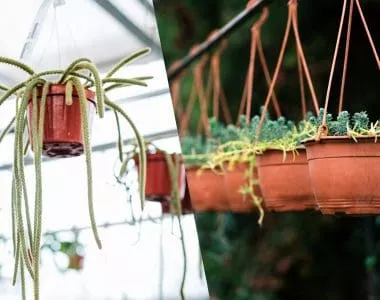
Does this ice plant not look pretty with its bright daisy-like flowers? Yes, you heard the name and thought, WOW, a plant I can grow in my icy winter garden.
It is the opposite, as this flora cannot tolerate icy cold winters. Great, but why call it the hardy ice plant? Read on to find out and learn how to care for your Delosperma cooperi outdoor plant and why it has that name.

Why Call It The Hardy Ice Plant?
To answer the question, it is all about what this flora looks like. The vegetation thrives alongside coastal regions in South Africa, Australia, the Mediterranean, and even the United States.
The succulent belongs to the Aizoaceae family meaning stone and face, as it has fleshy stonelike foliage. The exciting thing is the white dots resembles ice crystals, giving it its name, the ice plant Delosperma cooperi.
While they grow wild on shorelines, gardeners place them in rock gardens. Or use them as container plants for a bright display of light green leaves and frost or ice crystals.
The daisy-like flowers brighten up the home, making for fun indoor plants. To some extent, they look like space plants.
So, as you can see, it is not cold-hardy greenery but drought-tolerant, and the leaves have tiny hairs on them. The ice plant grows to six inches and can spread up to two feet.
Now that you know what this evergreen foliage is with its brightly colored flowers, add some fall color to dark spots in your garden today.
Ice Plant Delosperma Cooperi Care

Typically the purple ice plant blooms in spring, and you see the purple flowers throughout summer. Also, this outdoor plant is fast-growing; you can enjoy daisy-like flowers when taken care of.
Best Potting Mix for Purple Ice Plant
Okay, the ground needs to be fast and well-draining for your ice plant, whether grown outdoors or as a container plant.
The problem is that this plant does not like wet soil and can die. So, if you have clay ground, it does not thrive and needs amending.
You can add a lot of gravel or sand to get the best results. Then, while in a cooler climate, you can plant your ice plant in mid-summer to get them established and growing as a ground cover by winter.
But if you live in a warmer climate, we recommend fall planting. These plants also need room to spread, so place individual plants about 18 inches apart.
Thus, we recommend using gravelly soil as it is a fast-draining soil allowing your plant to grow.
Ideal Lighting for Ice Plants
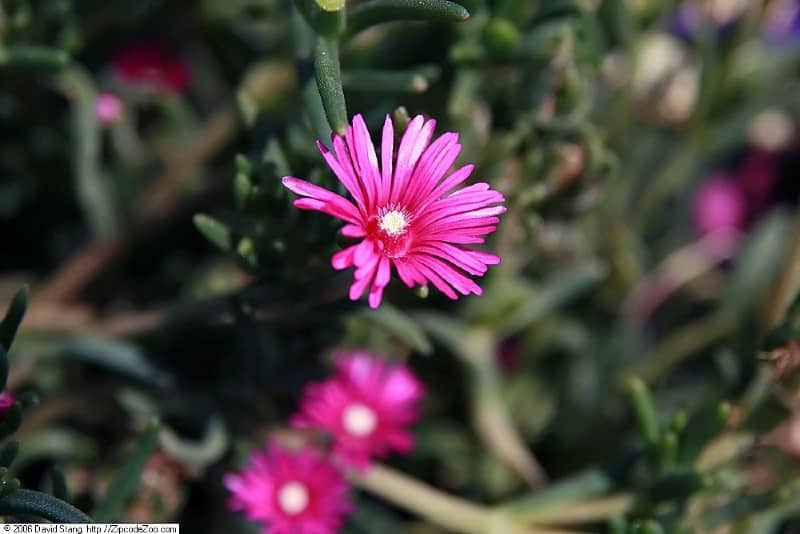
The hardy ice plant prefers basking in full sun as it allows those beautiful bi-color flowers to bloom. Yet, if you sun-starve your flowers, they get leggy, leading to weak growth. So treating them as outdoor plants would be best for these beauties.
So, provide your plants with direct sunlight for at least six hours while kept indoors. Unlike your Lillies, Roses, or Orchids, this plant is a real sunbather.
Still, you can grow them in partial shade, but full sunshine is best to get their maximum growth.
The Tricky Part of Watering
When it comes to watering your succulent evergreen, it all depends on where you plan to keep them. So, providing enough water is not a big concern but how much water you need to give is a concern.
When watering ice plants, there are limitations, and importantly, whether grown as an indoor plant or outside drainage is of most importance.
When any Aizoaceae plant sits in water, it starts to wilt away. That is why porous soil is essential. Further, the watering schedule for garden plants differs from house plants in the Delosperma cooperi.
If you grow your ice plants with sun exposure outside, you can let the rain take care of them. Then, you can provide your plants with water when drought-like conditions occur, and they are happy.
The truth is that they have little maintenance, and with good drainage, the foliage only needs about 18 inches of water a year. How amazing is that?
It helps to saturate them well once a week when grown indoors. But many botanists agree that watering every ten days is enough.
So, the rule of thumb is that the soil stays consistently dry before watering again. Another important note is it also depends on the time of day you water your ice plants.
We recommend giving them water later in the day and providing them with enough light to ensure the water dries off the leaves.
Temperature & Humidity Needs
Luckily when you grow your ice plant indoors, you have no worries about the temperature that much. The truth is that these frost blanket flowers can survive temperatures dropping to 35°F (2°C).
So, when you keep the temperatures above this range, your plant will do just fine. The main concern is that when you grow them outside and it is freezing, it can lead to winter-killed stems.
These plants can tolerate cold temperatures to a certain degree but prefer hot climates. The other good news is that succulents do not like high humidity, leading to fungal diseases and root rot.
So, as an indoor plant, do not mist them and avoid placing them in rooms such as the kitchen or bathroom with high humidity.
Fertilizer Needs for Your Plants
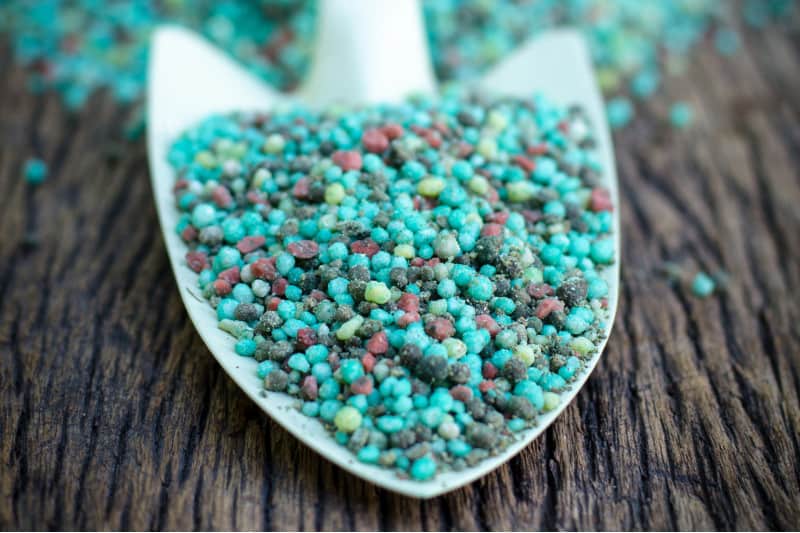
The ice plant displays the most beautiful blooms ranging in pink, yellow, orange, and more. If you provide your greenery with soil high in nutrients, you may not need to feed them.
But if it lacks nutrients, you can use a slow-release fertilizer in spring to help promote growth. Doing this allows your plant to have a long blooming season.
Propagation of Ice Plants
There are different ways to propagate the hardy ice plant, from seeds to cuttings. But we decided to share the more straightforward method with you, stem cutting. The best time to take a stem cutting is in the growing season, around spring or fall.

Stem Cutting Propagation Steps:
- Use sterilized shears and choose a parent plant you want to take a cutting. You can cut up to four inches.
- Remove the leaves and leave about two at the top.
- Leave the cutting overnight to dry out.
- Fill your potting medium with soil made for succulents with enough drainage holes.
- Wet the soil well, leave it to drain, and place the stem about two inches deep in the ground.
- Wet the soil again and leave it to drain as your young plant prefers moisture compared to adult plants. But never leave your ice plant sitting in water.
- Place your baby in a warm room in indirect sunlight as full sun can burn it.
- Keep your cutting saturated and keep an eye on it for a few weeks.
- Once you can gently tug on it without moving, the roots have established.
- Now, you can transfer your Delosperma cooperi to a bigger pot or plant it outside.
Growth Zone

You can grow your pink carpet outside in USDA hardiness zones 6-10, and it will provide a bright splash to your garden from summer to fall. But you may find some of the leafage dies in the winter months.
Potting and Pruning
When grown indoors, your container plant needs no repotting as it does not grow crowded as the roots are small. You might only transplant them if they are too long in wet soil.
So, you need to remove them and leave the roots to dry out in the fresh ground. Another thing is that this evergreen is an unruly grower and becomes a bit leggy.
Low-maintenance foliage needs no pruning but might need some trimming back to help the lovely flower grow.
The best time to do this is after it blossoms and withers. Then, you can remove the wilted flowers and dead foliage in the fall.
The same applies if your greenery has taken a hit with a cold draft in your home. So, clip the stems to the base for them to grow back.
Delosperma Cooperi Plant Varieties
Delosperma ‘Alan’s Apricot’

The evergreen is cold hardy and blooms in summer, with pink flowers fading to a tint of apricot.
Delosperma dyeri Red Mountain® Flame

The greenery has scarlet-orange blooms from mid-spring and is cold, hardy, and has heat tolerance.
Delosperma Lavender Ice

This is another long-blooming foliage with pastel pink and lavender blooms found in the growing season. Over winter, the leafage turns purplish, making for a colorful display in your home or garden.
Plant Diseases & Pests
As with most plants, your pink carpet is victim to pests and diseases, as seen here:
- Root rot is the primary concern, and the leaves turn yellow, starting to fall off. To solve the problem, remove your ice queen from its container and leave it out for the roots to dry and repot after a few days.
- Too much fertilizer can fail to bloom as it receives too much nitrogen.
- Aphids and mealybugs might pester your ice queen, and the best is to give her a hard spray with water.
Whether you want to buy, sell or simply reach out to other plant enthusiasts, Plantly is the right place to be!