The Echeveria spp. is one plant species you must get your hands on. These native desert plants, known as hens-and-chics, are gorgeous with their unique colors and make for a great house plant, even if you do not have a green thumb.
So, no matter what, Echeveria plants you decide to buy, this article covers all the basic care for Echeveria.
More About Echeveria Species

In the Echeveria spp. you find over 150 species to choose from, and it is one of the most popular succulent plants. Why? These house plants have a lovely rosette reaching up to 6 inches and a short stem with water-storing leaves.
The Echeveria plants are native to South and Central America to Mexico. You find them in various sizes, colors, and leaf shapes. Growing Echeveria in the right conditions gives you bell-shaped flowers to brighten your living space.
Still, you must handle these plants carefully as the leaves break easily. Still, it makes a great indoor plant if you have a busy schedule, as it is low-maintenance and can survive on some neglect.
The most stand-out feature of these succulent plants is the foliage displaying purple, pink, to silver-green leaves. Sometimes you also see a display of blue-green leaves. Another notable thing is that the succulent belongs to the Crassulaceae family.
Echeveria Plant Care Tips
The Echeveria succulents look fabulous in succulent gardens but grow well indoors. You can find different Echeveria types to grow indoors and outside. They thrive in a bright, dry environment but never let water sit on those delicate leaves, as it can result in fungal diseases.
Best Potting Mix For Succulent Plants

Echeveria needs well-drained soil that will dry out fast to prevent moisture from building up, leading to root rot. The soil must be the same as with most other succulent plants as they are drought tolerant.
So, the best potting medium is to mix some soil and perlite. Or you can invest in a cactus potting mix found at most garden centers and nurseries. Alternatively, you can mix three parts of regular potting soil with two parts coarse sand and one part perlite.
Ideal Lighting Conditions To Grow Echeveria

These plants, with their fleshy leaves and rosette form flushed with a red or pink border glow when the lighting conditions are right. The important thing is to provide them with bright indirect light indoors.
Echeveria indoors needs a lot of sunlight near a south or west-facing window. This is because your plants get more light at these spots compared to the east and north-facing sides. Still, if you have no option, place them near a window where they can get enough light.
Alternatively, you can place them underneath a table lamp during the day, as it will prevent your plant from developing tall stems stretching for light. For Echeveria outdoors during summer, avoid placing them in direct sunlight as the afternoon sun is harsh on the waxy leaves.
So, provide your plant with some direct light in the morning with partial shade in the afternoon. Your plant needs at least six hours of bright light in winter and eight hours in spring and summer.
Also, turn your plant Echeveria once or twice a week to allow them to grow in a uniform shape.
Watering Echeveria Plants

For watering, Echeveria care tips all depend on the condition and temperature of the surroundings of your plant. So, from spring to summer, it helps keep the soil moist by giving them deep watering and allowing the soil to dry in between.
Then from fall to winter, you should not wet your plants often, and best leave the soil dry before watering. Hence, depending on the environment, you can expect to water your new plant every week or every ten days.
Still, it depends on the size of your plants and the pot, and best to check the soil first using your finger or a moisture meter.
Temperature & Humidity

Your succulent thrives in dry, warm temperatures and is not cold-tolerant. Yet, neither do they enjoy too much humidity, and the average household temperature with humidity levels is acceptable.
The Echeveria succulent is hardy up to the USDA zone 9a to grow in the ground as the winter temperatures are average. Still, for wintery icy regions, we recommend bringing your plant indoors to overwinter.
When you provide your plants with temperatures between 65°F and 70°F, they will be fine.
Prevent Fertilizer Burn

Regular feeding is not a must with the Echeveria. The reason is that they grow in nutrient-poor soil. Furthermore, they can quickly get fertilizer burn if you overfeed them. Therefore, the best time to fertilize is spring and summer during the growing season.
We recommend a cactus or a succulent fertilizer with a ratio of 20-20-20 in a liquid form. You can fertilize your plant two to four times more and choose a low-nitrogen fertilizer for young plants.
Potting and Pruning Echeveria plants
A crucial part of Echeveria, as with other succulents, is to use the right pot. The ideal size of the container needs to be 5 to 10 percent bigger than the current size of your plant at the surface.
The best pot is an unglazed pot made of terracotta with enough drainage holes to allow excess moisture to drain from the container. Another added benefit of an unglazed pot is enabling the roots to cling.
When you transplant, your mature plants do it before the growing season starts, as it allows them to adjust to their new home. You can check the roots for damage and rot to prune away damaged or rotted roots. Remember to provide your plant with well-draining soil.
You can also prune your Echeveria plant occasionally to help prevent rot, and it encourages growth. If your outdoor plant becomes leggy, trim them to make them attractive.
The best time to do this is at the start of the growing season. With mature plants, you will find the lower leaves withering away, and you can gently remove them by pulling them off.
How to Propagate Echeveria Plants

You can use leaf cuttings, sow seeds, and stem cuttings for the offsets. The best time to take cuttings is in spring.
Succulents Stem and Leaf Propagation
Prepare a pot with enough drainage holes with cactus mix and keep a plastic bag or a transparent dome on hand.
From the mother rosette, separate a leaf from the main stem by wiggling it from side to side. But ensure to take a few leaf cuttings; use sterilized scissors to snip a leggy stem for stem cuttings.
You can snip or pinch it off the main branch using a pup or an offset growing from the main stem.
Lay your cuttings or the offset flat on your tray to let it be callous for a few days.
Then, I misted the soil in the pot and planted the calloused end into the soil. Please give it a misting until you see new sprouts, and leave it in a sunny location but not in direct sunlight. Keep it covered with a plastic bag and remove it daily, allowing air circulation.
In about a month, you will notice a small rosette form at the end of the leaf and leave it be as the old leaf will wilt and die.
Growing Echeveria From Seed
You can scatter some seed on soil or a cactus mix in a terracotta pot or another container. Moisten the soil and cover it with plastic wrap or a zip-log bag. Please leave it in a bright room out of direct sunlight.
Another important thing is to uncover the pot once a day for about an hour. The seeds should start germinating after about three weeks. Once the seed sprouts and forms tiny rosettes, you can remove the plastic and moisten the soil.
Famous Echeveria Varieties
Glaucous Echeveria

Echeveria secunda, or Compton Carousel, received the Royal Horticultural Society Award of Garden Merit. Another popular name is the Blue Echeveria, previously known as the Echeveria glauca. The flower stalks are bi-colored in pink with yellow tips.
Perle Von Nurnberg Echeveria

A beautiful succulent plant with a purple color along the rosette edges but is not cold hardy and best grown in containers. The Perle Von Nurnberg starts evergreen to gray, turning pink to purple in full sun. The flowers are pink with yellow tips.
Dusty Rose Echeveria

The Dusty Rose has this name for a good reason, as the Echeveria forms a powdery violet rosette with freely offsetting clusters. Like the other plants, it needs well-draining soil with enough sun and moderate watering.
Woolly Rose Echeveria

Doris Taylor is a favorite succulent collector with pale green foliage, and the leaf tips vary from dark to light with fuzzy hair. It looks attractive when grown in a white container and placed on display.
Afterglow Echeveria

The succulent with its fleshy leaves you recognize easily with the pink edge. The blooms range from red to orange flowers forming below the lower leaves.
Raindrops Echeveria
The succulent plant displays green leaves with a red dinge found at the margin. Sometimes you find green to blue bumps on the surface looking like raindrops. It is a hybrid and one of the smallest bumpy-leafed species of Echeveria.
Elegans Echeveria
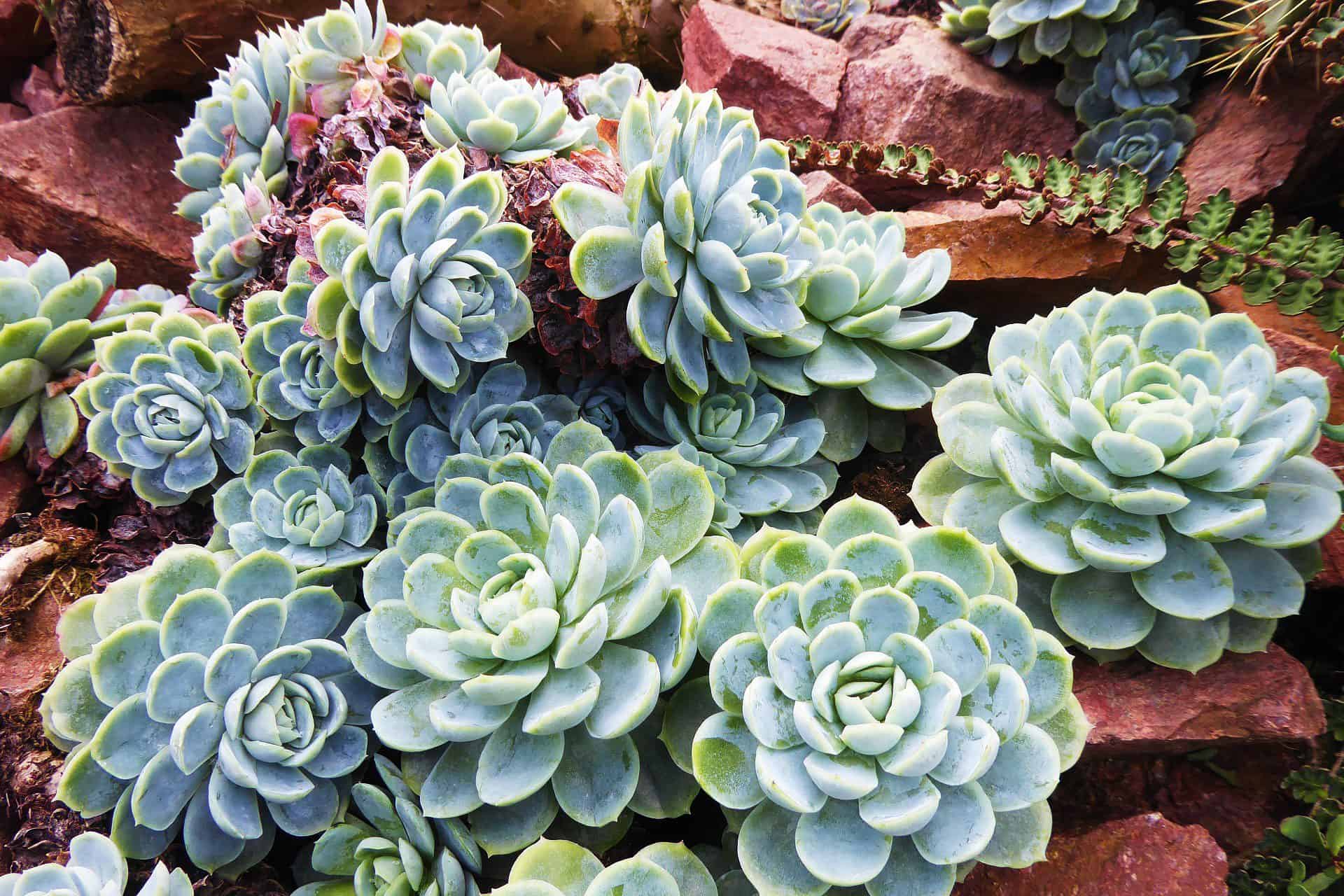
Echeveria elegans or Mexican Snowball is another Echeveria plant that received the Award of Merit from the Royal Horticultural Society. In early spring, you see pink flowers with yellow tips.
Topsy Turvy Echeveria

The Topsy Turvy grows mostly yellow flowers but can also be found in bright orange. Bloom time is from spring to late summer. You see the blooms on top of tall arching stalks.
Ghost Echeveria

The Ghost also gets its name from the color display forming in the leaves. The botanical name is Echeveria lilacina, with dusty leaves with a lilac hue.
Echeveria affinis

The Black Echeveria plants are unique, with short-stemmed rosettes and fleshy pointed leaves. It displays brownish olive hues on the foliage with a yellow-green base. The Black Echeveria produce flowers in bright red and star-shaped in summer.
Echeveria Azulita

Another gorgeous specimen anyone would love to take a leaf cutting to propagate is the Azulita with a small rosette in an icy blue color. The leaves have a powdery coating with gorgeous red tips. Check out our complete care guide for echeveria azulita here.
Neon Breakers Echeveria

Another unusual succulent plant is the Neon Breakers with colorful blue-green leaves when it starts to grow to turn faint pink at the tips.
Echeveria Common Diseases and Pests
The most common pests are spider mites that pester your Echeveria. Furthermore, the biggest concern is watering and not enough light. If you notice browning or blackening leaves, it can be from overwatering or too much humidity. While wilting and yellowing foliage with leaf drops is also from overwatering, insect activity can kill your baby.
Finally, when leaves fade and look limp, it is a lack of water.
More in this group: Best Types of Tall Succulents You Can Grow