If you need a hardy yet famous tree providing low-maintenance and fast-growing shade, then you need the superior hybrid poplar trees. These poplar trees are privacy screens while adding visual interest in fall.
More About Superior Hybrid Poplar Trees
Hybrid poplar trees are an excellent choice if you need a shade tree as it grows up to 8 feet a year to reach 30 feet tall. It is a hassle-free, disease-resistant tree, growing in different soils to light conditions.
The poplar trees grow in a pyramidal form and have triangular leaves that are up to six inches long. The foliage looks silvery green at the top with pale green undersides. When fall arrives, the foliage turns to a bright yellow and drops in winter.
The superior hybrid poplar tree you find is classified as softwood. The hybrid poplar cross-breeds between fast-growing specimens like the balsam poplar, Lombardy poplar, Populus deltoides (cottonwood), and quaking aspen. A fact is that it comes from the Willow family
Furthermore, the poplar species are now farmed for paper and pulp. So, superior hybrid poplars have many benefits of growing faster than other softwoods. In addition, it is disease resistant with minimal maintenance and develops stump sprouts for the next tree production.
Some farmers are even planting hybrid poplars for biomass fuel for wood-burning electrical plants to ethanol production. Why? The hybrid poplar produces at a full sun growth rate and fast-growing trees.

Hybrid Poplar Care

If you live in the USDA hardy zones 3 to 9, the superior hybrid poplar tree grows well without any concerns. Still, they do not grow in freezing or hot temperatures like in Minnesota, Florida, or Texas.
Planting Hybrid Poplar Trees
The best time to plant your hybrid poplar is in spring or fall. It helps to choose a planting site that provides the tree enough space to grow away from the home or power lines. Also, clear any debris, weeds, or turfgrass before digging a planting hole.
Then dig a hole at the same depth as the hybrid poplar tree root ball three times wider. Next, remove your poplar tree from the container and spread the roots using your fingers or a small spade. Now, backfill the hole, and at halfway, add water.
Leave the water to drain away and complete the backfilling. We recommend adding a three-inch layer of mulch around the hybrid poplar tree root zone to help retain moisture without touching the trunk.
A helpful tip when planting your hybrid poplar trees is to find the best planting depth, the top of the root flare where you see the trunk and roots meeting up.
Soil
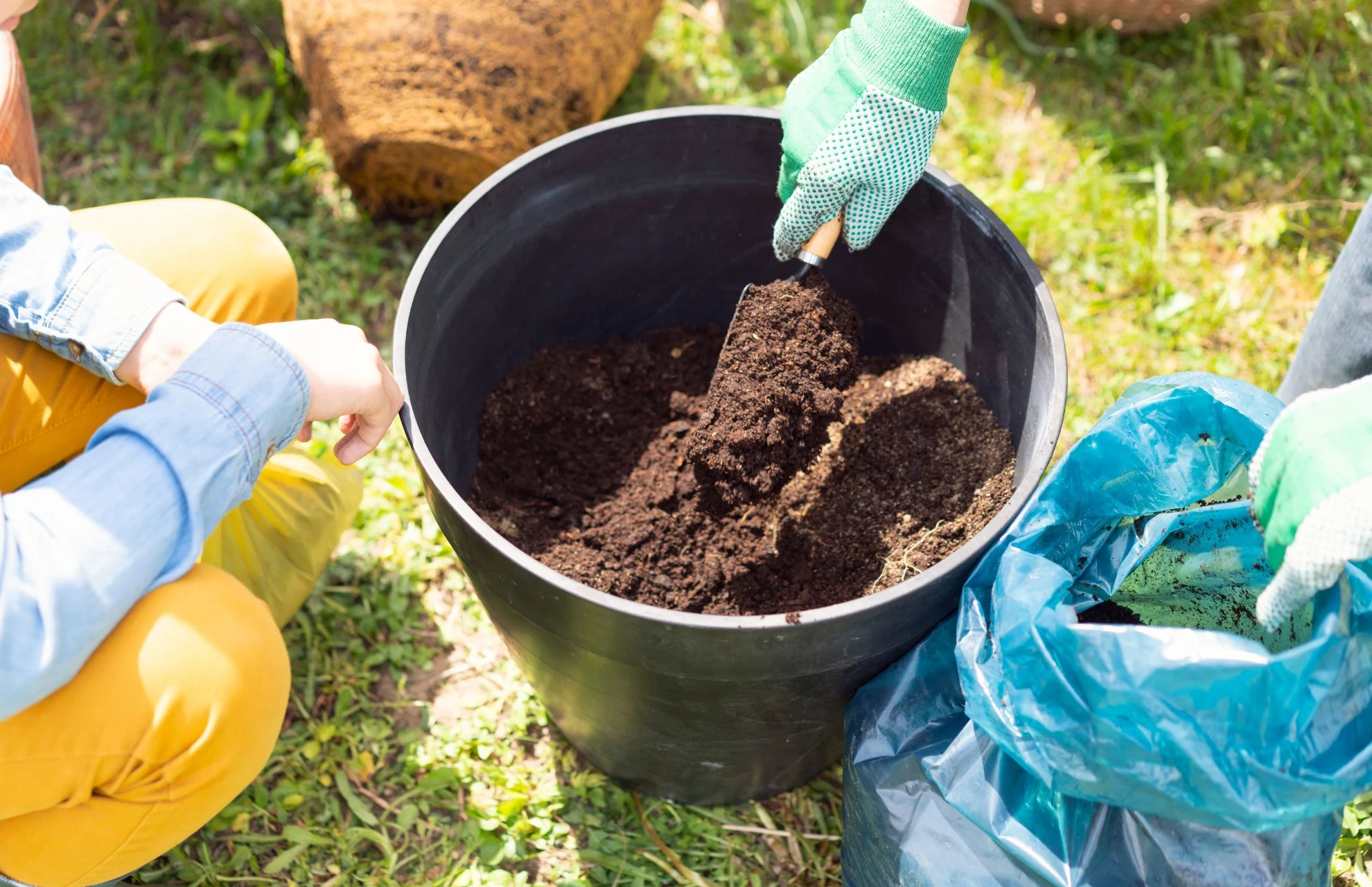
Hybrid poplar grows in different soil when growing in the ground in landscaping as long as it is well-draining soil. The soil must conserve moisture and allow excess water to drain freely. Hence, it can prevent root rot or fungus from attacking the trees.
Light
Hybrid poplar trees thrive in different lighting conditions and are adaptable to grow in unfiltered sunlight to part shade. Hence, these poplars grow well in full sun to partial shade. Your tree will have a full sun growth rate to turn into a wonderful shade tree.
Water
No matter what species of poplar trees you have, from the Balsam poplar, Lombardy poplar, or the superior hybrid poplar trees, they need regular watering.
The best for proper care is to provide your poplar tree with an inch of water weekly, depending on the rainfall. You may find you need to water often in summer and less in winter to keep the root system happy.
So, give your tree a good soak and leave it to soak deep into the soil. We do not recommend keeping wet soils as it might lead to the rotting of the roots. If you feel moist soil refrain from watering your superior hybrid poplars.
Fertilizer

During the planting of your poplar trees in early spring or fall, it is not advised to fertilize them during the first season. Yet, you can provide your hybrid poplar trees fertilizer in fall using a 1/2 pound of feed for a 1/2 inch trunk diameter measured at the base. You can use one pound for each inch if your tree is big.
Pruning
It does not need much trimming when it comes to pruning your poplar tree. The hybrid poplar grows naturally into that pleasing oval shape. Therefore, winter or early spring is the best time to remove branches.
You can do this before new growth appears. It is recommended never to remove more than 30 percent of the overall mass. You can prune dying, damaged, dead or diseased branches anytime.
Propagation
The best way to propagate this fast-growing tree is through hardwood cuttings you harvest during the dormant phase. We recommend you keep the cuttings in a cool, moist condition for successful rooting.
Gather some cuttings about 5-8 inches long from the tip of the side branches. Preferably choose cuttings with no leaves with a diameter of 1/4 inch.
You can cut them with sharp shears beneath a set of leaf buds at a 45° angle.
Remove the silver bark on the severed end using a utility knife.
Leave the cuttings to soak overnight in a bucket of water with the severed end in the water and the tip exposed.
Prepare your potting medium by mixing equal parts coarse sand and perlite in a bucket.
Throw the potting medium into ten-inch containers and leave the top section empty.
Next, run water through the pots leaving the soil saturated, and let it drain for half an hour.
Remove the hybrid poplar cuttings and apply 0.1% indolebutyric acid, a rooting hormone, to the cut end with a cotton swab.
Insert the cutting into a half-length container and press the mixture against the base to make contact with moist soil and cutting.
Place the receptacle in partial shade to protect it from winds.
Keep maintaining the moisture and water when you feel the top two inches dry.
You can check for new growth every eight weeks and leave them in the container until spring to transplant into a loamy, well-draining soil in the landscaping with enough sun.
Poplar Varieties
Poplars are the fastest-growing trees and can be found in different varieties.
Populus nigra
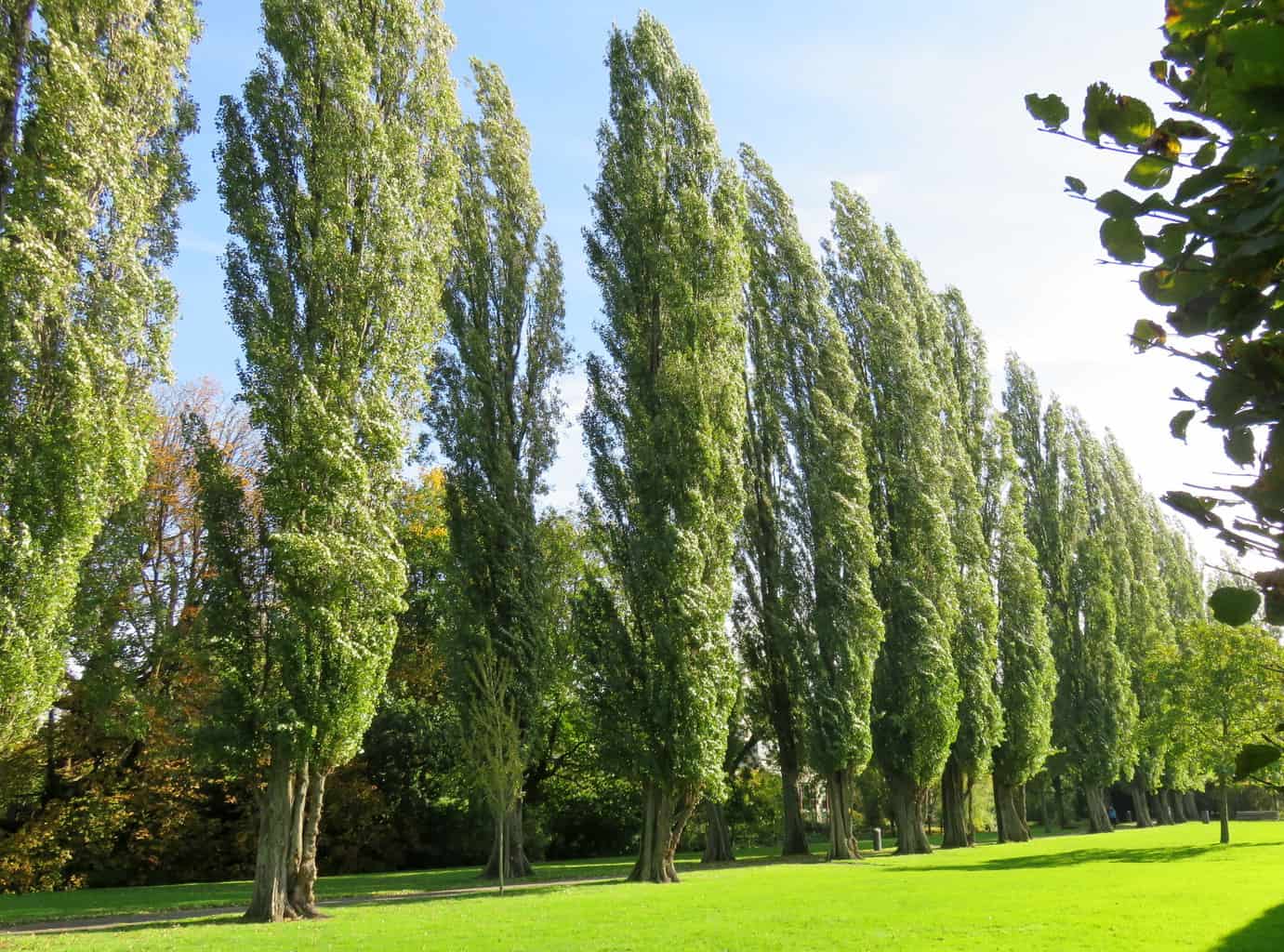
The black poplar trees can live up to 200 years and have a growth rate of up to 50 feet tall. It has dark brown to black bark with wide fissures and burrs. The twigs come over lumpy and brown, and the leaves have a balsam scent.
During winter, mature trees’ twigs look knobby, and the buds spiral around the twig and are very dense. The leaves are heart-shaped with long tips and covered with fine hairs shed in fall. The poplar tree is dioecious, and the flowers are male and female on separate trees.
The male catkins (flowers) are red, while the female is yellow-green and pollinated by wind. Once the blooms are fertilized, fluffy seeds develop that fall to the ground in late summer.
Populus alba
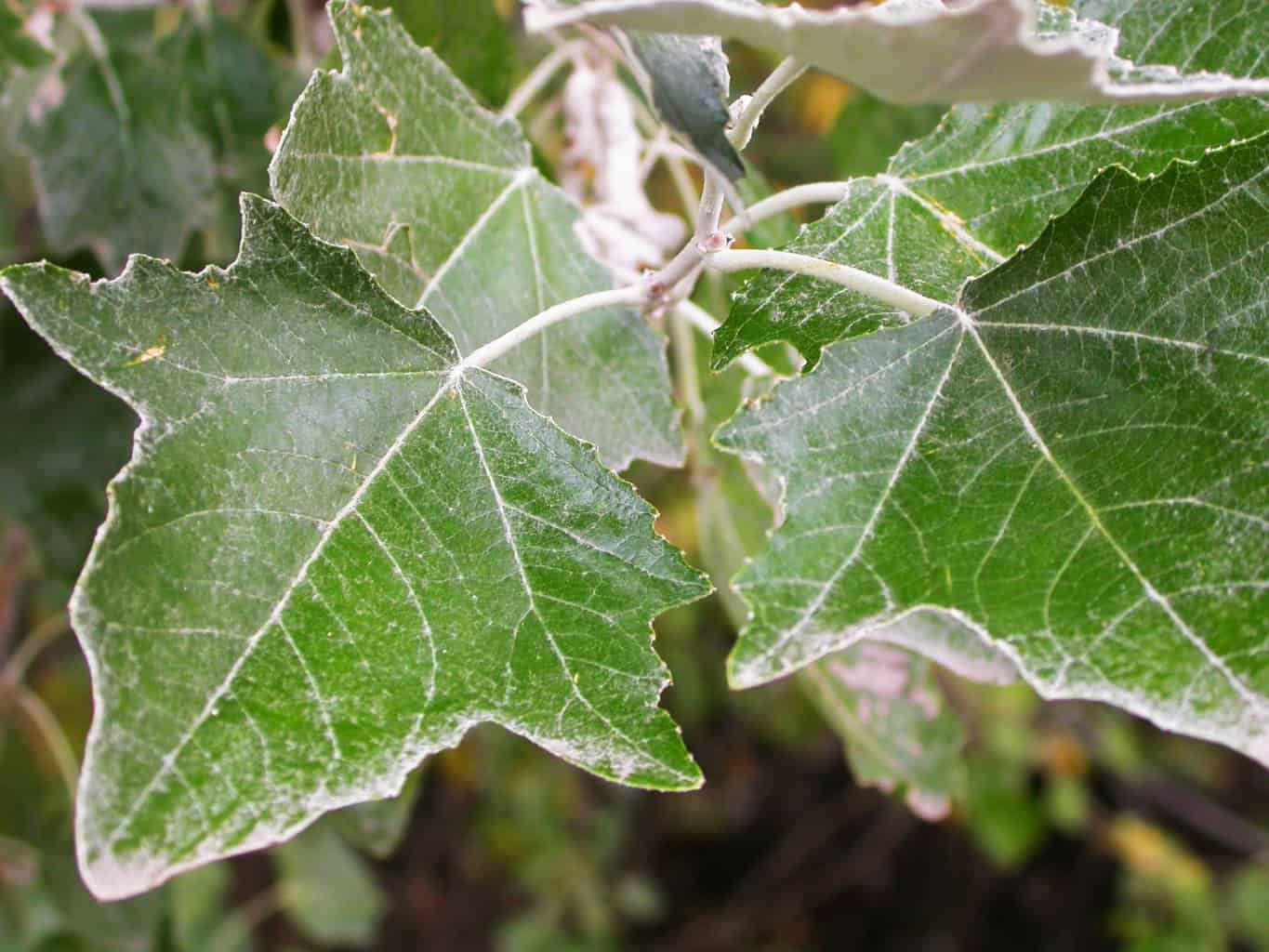
Many people confuse the black poplar with the white poplar trees. The tree is hardy and looks magical in the landscaping. Yet, looking at the tree from a distance, it seems like it is covered with snow.
The poplar tree is deciduous, with a broadleaf growing up to 30 feet tall. Compared to the other poplar trees, it has a pale gray bark with black diamond-shaped pores known as lenticels. It has white twigs, and when young, it is covered with white hair.
The underside of the leaves is more paper than the top side while the stems are flattened. Winter is the time that it looks as if it is covered in snow. As with the poplar black, it has male and female flowers pollinated by the wind.
The white poplar trees also develop cotton-like seeds that fall to the ground in summer.
Common Pest and Disease on Superior Hybrid Poplar Trees
These shade trees are pretty pest and disease-resistant. Still, several poplar types can become the home to bugs like caterpillars, aphids, mealybugs, borers, and scales. Regular maintenance and using insecticides like neem oil and more can prevent infestations.
We advise avoiding using pesticides as they can harm other pollinators. Another concern is fungal canker diseases with this tree. The condition girds the limbs and causes the branches to weaken and eventually die.
For the fungal bacteria, it helps to use a strong fungicide to save all the infected branches. Unfortunately, the superior hybrid poplar trees are not deer resistant as they chew the leaves on young saplings.
The bark is also delicious for rodents, rabbits, and porcupines, so it will need protection when young.
Whether you want to buy, sell or simply reach out to other plant enthusiasts, Plantly is the right place to be!